
101


WHEN LUNGING HAS REAL
TRAINING VALUE

WHAT HORSES CAN GAIN THROUGH
CORRECT LUNGING
When performed correctly, lunging can improve the horse's balance, posture, rhythm, flexibility, strength, self-carriage, responsiveness, and overall understanding of the aids while providing the handler with a valuable opportunity to observe and evaluate movement.
CORRECT LUNGING:
-
Ensures proper warm-up time for the horse
-
Allows the horse to learn without the weight of the rider
-
Improves focus and responsiveness to aids
-
Improves vertical balance, self-carriage and coordination
-
Improves rhythm and regularity of the gaits
-
Improves transitions between gaits
-
Increases flexibility and symmetrical muscle development
-
Encourages relaxation and cooperativeness
-
Preconditions the horse physically and mentally for ridden work
The handler can help the horse establish straightness by practicing various figures and making use of the entire arena.


#1 Using"Lunging" to Burn Off Excess Energy
When lunging is used simply to tire out horses before riding, it not only teaches them to become overly excited or anxious, creating behavioral problems, but also encourages them to move out of control.
Horses that are routinely allowed to "take off" as soon as they enter the arena are not being correctly prepared for work.
Without a proper warm-up, the muscles, tendons, ligaments, and joints are subjected to sudden stress, increasing the risk of injury or tissue lesions.
Incorrect lunging can lead to excessive loading of the inside limbs, reduced engagement of the hindquarters, loss of self-carriage, asymmetrical muscle development, body stiffness, fatigue, loss of motivation to work, potential aggravation of pre-existing lameness.
—THE LIST CAN GO ON...
WHEN LUNGING LOSES ITS
TRAINING VALUE
DOES YOUR HORSE TEND TO...

"The imbalance and discomfort may result from the training equipment and the way it is used."


WHAT HORSE OWNERS KNOW ABOUT
AUXILIARY REINS
Throughout the history of horse training, countless tools have been invented to meet people's needs.
Some of them are truly helpful, others have negative impact on the horse's welfare, and some are valuable for specific training approaches—but should not be used at all times or in all cases.
Many people tend to work their horses with equipment they have seen others use, expecting that it will offer a solution to their own training goals without truly understanding the function and long term-effect of these auxiliary reins.
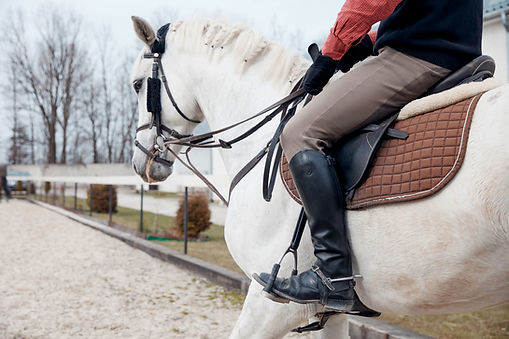


WHAT TO CONSIDER WHEN USING
AUXILIARY REINS
German String
-
It restricts the horse’s ability to stretch the neck forward.
-
Depending on the horse’s head and neck position, it exerts force on the tongue and lower jaw while also applying pressure to pectoral muscles and the spine.
-
In a short frame, it acts at a perpendicular angle on the tongue and lower jaw, which may lead to excessive tension in the poll, neck, and back muscles both in horses that evade the contact and those that resist the rein.
-
It can easily induce hyperflexion and pain throughout the body, potentially contributing to lameness and other musculoskeletal lesions.
WHAT CAN BE EXPECTED
FROM ITS USE?

Until one side of the rein is under tension, the other remains slack, resulting in uneven and inconsistent contact.

There is NO correct use of the German String, as it applies force in a manner that contradicts both biomechanical principles and horse-centered training methods.