top of page
Black Horse.jpg
VIVID HERITAGE EQUESTRIAN_edited_edited_edited.png

ABOUT US

At Vivid Heritage Equestrian, our mission is to improve the training experience of horses by helping riders make thoughtful decisions about the equipment they choose to use. Through clear explanations grounded in biomechanics and training principles prioritizing horse welfare, we aim to provide riders with a better understanding of how traditional auxiliary reins and training aids work and how they may affect a horse's movement, posture, comfort, and overall performance. Our goal is not only to identify potential concerns but also to offer effective, horse-centered alternatives while explaining how these tools are intended to be used to promote healthy training and clear communication between horse and rider.

101

Areal view of a girl training a horse.jpg

Is lunging helpful or harmful...

Lunging on bridle

WHEN LUNGING LOSES ITS

TRAINING VALUE

#1 Using"Lunging" to Burn Off Excess Energy

When lunging is used simply to tire out horses before riding, it not only teaches them to become overly excited or anxious, creating behavioral problems, but also encourages them to move out of control.

Horses that are routinely allowed to "take off" as soon as they enter the arena are not being correctly prepared for work.


Without a proper warm-up, the muscles, tendons, ligaments, and joints are subjected to sudden stress, increasing the risk of injury or tissue lesions.


Incorrect lunging can lead to excessive loading of the inside limbs, reduced engagement of the hindquarters, loss of self-carriage, asymmetrical muscle development, body stiffness, fatigue, loss of motivation to work,  potential aggravation of pre-existing lameness


—THE LIST CAN GO ON...

DOES YOUR HORSE TEND TO...

"The imbalance and discomfort may result from the training equipment and the way it is used."
Brown horse galloping around the racetrack and training_edited.png
VIVID HERITAGE EQUESTRIAN_edited_edited_edited.png

WHAT HORSE OWNERS KNOW ABOUT

AUXILIARY REINS

Throughout the history of horse training, countless tools have been invented to meet people's needs.

Some of them are truly helpful, others have negative impact on the horse's welfare, and some are valuable for specific training approaches—but should not be used at all times or in all cases.

Many people tend to work their horses with equipment they have seen others use, expecting that it will offer a solution to their own training goals without truly understanding the function and long term-effect of these auxiliary reins.

Horseback Riding

WHAT TO CONSIDER WHEN USING

AUXILIARY REINS

Rein length remains relatively fixed once adjusted

  • Depending on the type of auxiliary rein, it can restrict the lateral or forward-down movement of the horse's neck, creating a fixed, static frame in which the horse's mobility becomes restricted.

  • A fixed frame can promote altered head and neck carriage, in which the horse will try to resist or avoid contact on the bit with the intent of releasing tension in its body. 

German String


  • It restricts the horse’s ability to stretch the neck forward.

  • Depending on the horse’s head and neck position, it exerts force on the tongue and lower jaw while also applying pressure to pectoral muscles and the spine.


  • In a short frame, it acts at a perpendicular angle on the tongue and lower jaw, which may lead to excessive tension in the poll, neck, and back muscles both in horses that evade the contact and those that resist the rein. 

  • It can easily induce hyperflexion and pain throughout the body, potentially contributing to lameness and other musculoskeletal lesions.

What can be expected from its use?

German String.jpg

Until one side of the rein is under tension, the other remains slack, resulting in uneven and inconsistent contact.

German string faulty.jpg

There is NO correct use of the German String, as it applies force in a manner that contradicts both biomechanical principles and horse-centered training methods.

If you are looking to...​

WHAT TRAINING AID SUPPORTS

EQUINE BIOMECHANICS

EquiBalance® Horse Training Equipment by Vivid Heritage..jpg

®

EQUIBALANCE
 

Building the Foundation for Collection through

 Balanced Contact & Flexible Frame 
 

The EQUIBALANCE® System was designed through a biomechanical approach that overcomes the limitations of traditional auxiliary reins.

VIVID HERITAGE EQUESTRIAN_edited_edited_edited.png

Horse Training Equipment Inspired by
Equine Biomechanics

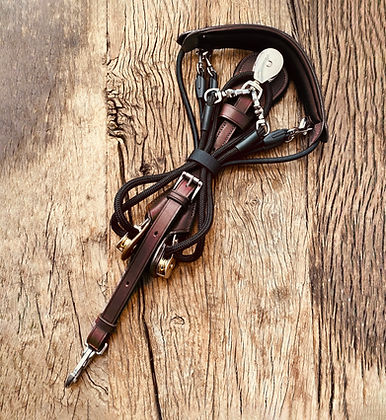
The EquiBalance® Training Rein and Cavesson were created for riders seeking a horse-centered lunging aid that prioritizes comfort, effectiveness and biomechanical function to support relaxation, flexibility,  symmetrical muscular development and improved proprioception.


The EquiBalance® Training Rein not only maintains  consistent and perfectly even contact on both sides of the bit, but also allows unrestricted lateral and forward-down flexion of the horse's neck.

​​

As a result, the EquiBalance® System does not create unnecessary tension or force the horse into a fixed position.

​​

MAHAGONI EQB Premium.jpg
Horse free training session with the EquiBalance® Training Rein, showcasing precise rein a
VIVID HERITAGE EQUESTRIAN_edited_edited.png

RELAXATION DURING TRAINING IS

FUNDAMENTAL

​"Allowing the horse to stretch  the neck and topline is essential for relaxation and, ultimately, for improving collection."

The EquiBalance® Training Rein ensures a comfortable, consistent and perfectly even connection, allowing the horse to find relaxation and confidence to fill the frame in collection.
_V5I0166.jpg
_V5I1248_edited.jpg

A GAME CHANGER

WHY LUNGING WITH A CAVESSON IS

The Cavesson offers a reliable point of contact for the lunge line:

  • to protect the horse's mouth from undesired pressure

  • to prevent the excessive rotation of the poll 

  • to facilitate correct lateral and forward-down flexion

  • to improve weight distribution and coordination

It is recommended to attach the lunge line to the cavesson ring rather than the bit to preserve the horse’s comfort and the undisturbed function of the EquiBalance® Training Rein, both of which are essential for encouraging the horse to confidently fill the frame. 

VIVID HERITAGE EQUESTRIAN_edited_edited_edited.png

Why Riders Choose 

®

EQUIBALANCE 

Across different countries, disciplines, and training goals, riders found the EquiBalance® System beneficial for improving contact, flexibility, posture, self-carriage, healthy muscular development  and the overall performance of their horses.


Riders find the EquiBalance® System an effective training aid for:


✔ Starting young horses
✔ Re-schooling horses
✔ Relaxing competition horses

✔ Supporting the posture of  school horses
 

EquiBalance® Training Rein _ Lunging Aid.jpg
_V5I0153 (1).jpg
VIVID HERITAGE EQUESTRIAN_edited_edited_edited.png

HOW EQUIBALANCE 

MADE IT POSSIBLE

1. PRINCIPAL PULLEY regulates the rope rein's length ratio based on the direction of  flexion to maintain the balanced connection on the bit, while it ensures the unrestricted lateral movement of the horse's neck.

2. SIDE PULLEYS regulate the angle of the rope rein to maintain a comfortable and correct point of contact on the bit, while they ensure the unrestricted  forward-down movement of the horse's neck.

3. REGULATOR ELASTIC provides the flexibility and the safe position of the rein system  to adapt to the horse's dynamic movements.

4. NECK PIECE

The position of the neck piece and the length of the adjustable breast strap DETERMINE THE SIZE OF THE FRAME.


  • Moving the neck piece towards the poll creates a wider frame

  • Moving the neck piece towards the withers creates a shorter frame

A WIDER FRAME is recommended for those:

  • horses who have a tendency to go behind the vertical 

  • horses who have difficulty stretching forward-down 

  • horses who have just been started

A SHORTER FRAME is recommended for those:

  • horses who have a tendency to go against the bit

  • horses who have a tendency to raise their head too high

How to determine the correct size of the frame?​

Should be set according:

  • to the horse's neck conformation

  • to the horse's physical condition

  • to the horse's training level

Most importantly the training rein should be set long enough to allow the horse to stretch  forward-down to be able to relax the topline.​​​​​​​​​​

Alexandra VNg.jpg
VIVID HERITAGE EQUESTRIAN_edited_edited.png

MEET

EQUIBALANCE Alexa

Over the course of thirty years of riding, I have traveled to many countries to learn from excellent trainers—yet the most meaningful lessons have always come from the process of re-schooling and rehabilitating horses.

In my experience, discomfort, confusion, negative behavioral changes, and even the potential development of lesions in horses often result from the improper use or inefficiency of auxiliary rein systems.

Traditional side reins and draw reins are primarily focused on controlling the horse’s head position while overlooking the importance of mobility, balance, and a correct connection.

The EquiBalance® System was designed to overcome these limitations, and to offer riders an effective solution which can genuinely help with the horses' healthy progression.

​​

I trust that the efforts in providing guidance  ensures that the EquiBalance® System will be

~ used as intended and only when needed ~
as there is far more to lunging
than is generally expected

What Riders Say

5 Star EquiBalance Customer Rating

®

EQUIBALANCE 

Earning the Trust of Horses and Riders Around the World

EQUIBALANCE GUIDANCE
- beginning with the basics -

Learn how to use our horse training equipment to ensure optimal functionality, safety and comfort.

VERITAS 4y EquiBalance®
00:51
VERITAS 4y EquiBalance®
01:03
SAM 14y EquiBalance®
00:23
BERLIN 4y EquiBalance®
00:17
GIDRAN 12y  EquiBalance®
00:32
HECHIZO PRE 9y Before & After  EquiBalance®
01:32
HECHIZO PRE 9y EquiBalance®
00:32
bottom of page